
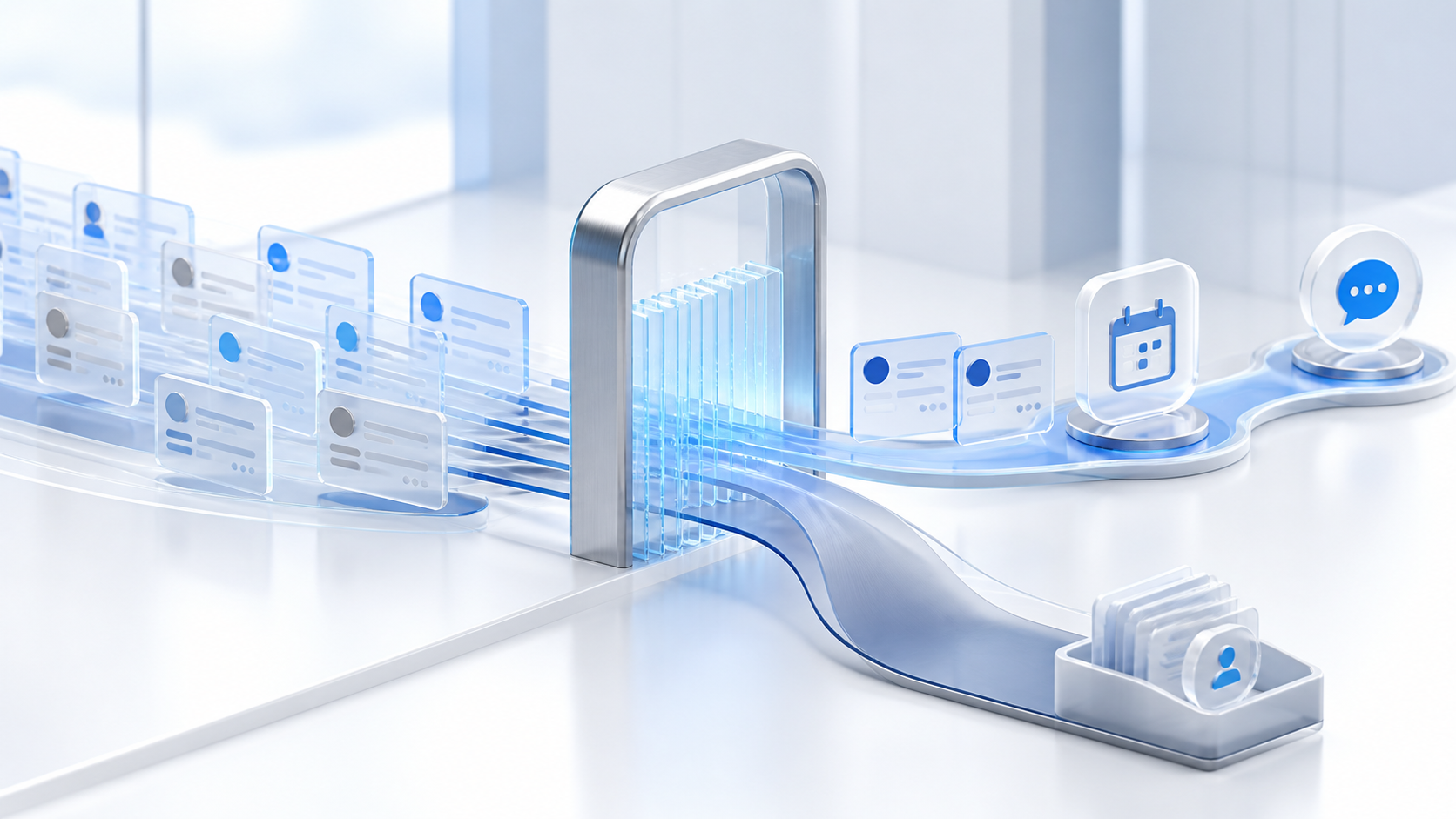
To qualify leads before a sales call, establish whether the prospect fits the service, has a real problem you can address, has a credible reason to act and can participate in the decision process. Collect only enough information to choose the right next step. Do not turn qualification into an interrogation or pretend that a form score can replace commercial judgement.
The purpose is not to keep people out. It is to protect both sides from an unsuitable meeting. A strong process routes a ready prospect to the right conversation, gives an early-stage contact useful guidance and closes poor-fit enquiries respectfully.
For an established service business, this matters because a full diary can conceal a weak pipeline. Ten calls with unclear need or no decision route are not necessarily more valuable than three well-prepared conversations with suitable buyers.
Define what “qualified” means before changing the form
A lead is not qualified merely because they completed a form, downloaded a guide or selected a large budget. Qualification is a business decision based on evidence.
Microsoft’s lead-management guidance describes qualification as validating that a lead represents a genuine sales opportunity before creating and tracking an opportunity record. Its lead qualification process also preserves disqualified leads as part of the audit trail rather than deleting inconvenient outcomes.
Your definition should reflect the service actually sold. A commercial website project, operational audit and CRM implementation need different evidence. Start with four dimensions:
- Fit: Is this the type of business, problem and engagement you can serve credibly?
- Need: Is there a specific commercial or operational issue rather than a vague interest?
- Timing: Is there a reason to act, a deadline or a recognised cost of delay?
- Decision process: Who is involved, what must be understood and what happens after the call?
Budget can be relevant, but it should not stand alone. A stated figure may be uninformed, provisional or controlled by somebody else. Equally, a prospect who will not share a precise budget may still have a valid problem and a credible buying route.
Separate fit from sales readiness
Fit and readiness are different decisions.
A suitable business may be too early for a sales call because it is still defining the problem, aligning stakeholders or gathering evidence. A ready buyer may still be unsuitable because the work lies outside your capability, geography, delivery model or ethical boundaries.
Use three practical outcomes:
- Sales-ready: suitable problem, sufficient context and a logical reason to speak now.
- Nurture or diagnose: potentially suitable, but the problem or decision route needs more clarity.
- Not a fit: the requirement falls outside the governed offer or cannot be delivered responsibly.
Microsoft’s qualification-criteria guidance separates criteria from the action taken after a lead qualifies. The useful operational lesson is that every outcome needs a route. A label without an owner and next action does not improve the customer journey.
Ask only questions that change the next action
Long forms often appear rigorous but collect information nobody uses. Before adding a field, write down why it is required, who uses the answer and which routing decision it changes.
The GOV.UK Service Manual recommends a “question protocol”: only ask when you know why the information is needed, what you will do with it, who needs to provide it and how it will remain accurate and secure. Its form-structure guidance also recommends branching so people only answer questions relevant to them.
A proportionate pre-call form might ask:
- Business name and website.
- The service or outcome being considered.
- The main problem in the prospect’s own words.
- What is happening now and why it is unsatisfactory.
- Timing or any fixed deadline.
- Who will participate in the decision.
- Any relevant delivery constraint.
Do not ask for sensitive personal information, revenue, detailed budgets or internal documents by default. GOV.UK’s personal-information guidance says collection should be minimised and proportionate to the problem being solved. The same discipline improves trust and reduces unnecessary handling risk.
Use progressive qualification
Qualification does not have to happen in one form. Progressive qualification collects evidence at the point it becomes useful.
Before the call
Use the website, enquiry form and confirmation step to establish broad fit, problem and timing. Explain who the service is designed for, what it covers and what happens next. Clear positioning can prevent unsuitable enquiries before a person needs to reject them.
During the first response
Confirm what you understood and resolve missing facts. A short personal reply can distinguish an urgent operational issue from general research. It can also redirect a prospect to a more suitable resource without forcing a meeting.
During the call
Explore consequences, current process, stakeholders, evidence and the decision required. Do not spend the call repeating every form question. Use the supplied context to ask better follow-up questions.
After the call
Record the result, next action, owner and date. Qualified, nurture and closed outcomes should be visible in one controlled pipeline. The article on revenue leaks across the customer journey explains how acknowledgement, ownership and follow-up should connect around this decision.
Build a simple qualification scorecard
A scorecard creates consistency, but it should support judgement rather than automate rejection blindly.
| Dimension | Evidence to review | Useful outcome |
|---|---|---|
| Service fit | Business type, problem and required capability | Correct service or respectful redirect |
| Problem clarity | Current state, desired change and consequence | Sales call, diagnostic or clarification |
| Timing | Trigger, deadline and cost of delay | Act now, nurture or close |
| Decision route | Stakeholders, approval and next decision | Invite the right people and define the call |
| Delivery feasibility | Access, constraints and working expectations | Progress, reshape scope or decline |
Avoid arbitrary totals such as “seven points equals qualified” unless evidence shows that the threshold predicts a useful outcome. Record the reason behind the classification. That makes later review possible and prevents one employee’s instinct from becoming invisible policy.
Design the call around a decision
A qualified call needs a defined purpose. “Discovery” is too vague if neither side knows what should be decided.
Before booking, tell the prospect:
- Who the call is for.
- What information will help.
- Who should attend.
- How long it will take.
- What will be decided or produced.
- What the possible next steps are.
This reduces avoidable calls and makes the meeting more commercially useful. If the prospect needs a diagnosis before a proposal, say so. If the service cannot be priced responsibly without reviewing the wider system, do not disguise a sales call as free consultancy.
Route early-stage prospects without abandoning them
Not ready does not automatically mean poor fit. A prospect may need to clarify the problem, validate internal demand or review the existing journey.
Offer one relevant route:
- A published guide that answers the immediate question.
- The Business Website Conversion Checklist for a low-commitment review.
- A later follow-up date agreed with the prospect.
- A focused diagnostic where the cause spans several stages.
The process should respect communication preferences and preserve suppression. Do not move every unqualified enquiry into promotional nurture without the appropriate permission.
Review the outcomes, not just booked calls
Measure whether qualification improves commercial progress:
- Valid enquiries received.
- Sales-ready leads accepted.
- Calls attended by the necessary decision participants.
- Calls that reach a clear next action.
- Diagnostics, proposals and wins by source.
- Nurture and closed outcomes with evidenced reasons.
- Time spent on poor-fit or incomplete enquiries.
Review false positives and false negatives. If many “qualified” calls reveal no real problem, tighten the definition. If suitable prospects are rejected because they cannot answer a specialist question, simplify it. If one source produces strong fit but low readiness, adjust the route rather than removing the source.
The wider guide to identifying lost-lead opportunities helps trace whether the leak occurs before qualification, during response or after the call.
Diagnose the system before adding more gates
Poor call quality may originate upstream. The website may attract the wrong audience, describe the offer too broadly or hide the real scope. Notifications may fail, responses may arrive too late or follow-up may be inconsistent. Adding form fields will not repair those causes.
The £297 Acquisition Audit is a five-working-day diagnostic of the website-to-enquiry journey, follow-up, CRM and relevant workflows. It identifies the first important conversion gap and provides prioritised actions with an implementation roadmap.
Use it when the business is booking calls but cannot explain whether weak outcomes come from positioning, capture, qualification, response or the sales process itself.